

AV Case Study: Swinburne University of Technology Projection Upgrade
Swinburne Uni has upgraded its monster Epson projector fleet. AV Manager Scott Doyle speaks to how it all fits into his standardisation strategy.

5 May 2026
Swinburne University of Technology covers a broad gamut of applied learning. AV in its spaces is hardly cookie-cutter. An animation lab has different demands on its AV to a plumbing barn, but they all rely on quality technology and an AV team managed by Scott Doyle.
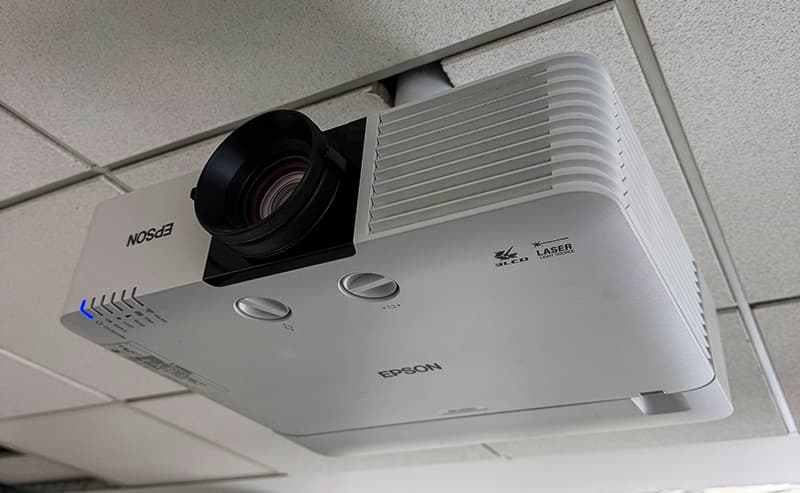
Scott has heavily adopted a philosophy of standardisation. I’ll let him explain why a bit later. One of the technologies he’s standardised on is projection. Since he took over the Swinburne role he’s steadily upgraded an all-lamp-based fleet of some 500 projectors to an all-laser-based fleet of Epson projectors, except for a handful of hold-outs that are specialised, pricey, and not near their end of life.
We met Scott at the Hawthorn campus in March. First thing I noticed is the number of students on campus. Since Covid some campuses have struggled to get students out of their bedrooms and back at uni, but not Swinburne. There’s a wide range of common areas for students to study and relax between classes. Equally, the digital approach to learning is providing students with options that conform to the reality of modern higher ed learning – students who live at home balancing work commitments with study commitments, balancing travel and remote learning.

CASE FOR PROJECTION
In an age of ever-larger LCD and LED panels, why does Swinburne remain firmly committed to projection? For Scott Doyle the answer is simple: size and cost.
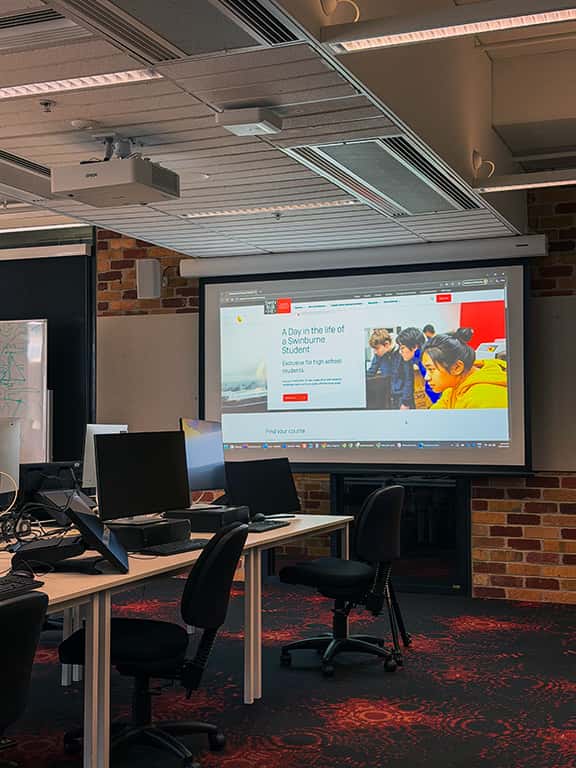
“We’ve standardised on a 110-inch image,” he says. “A 110-inch projection versus a 98-inch screen: with laser projectors we get the same lifespan and the same brightness. The contrast ratio is acceptable. It’s obviously not as good as a high-end display, but unless you’re doing specific graphics or 4K resolution work, you don’t need it.”
In film and television classes the university has installed 98-inch HDR-capable displays where specifications demanded it. The display would ideally be larger: “they’d love a projector to do that, but it’s unaffordable.”
FIRST FLEET: UPGRADE PATH
The fleet story is impressive. When Scott arrived in early 2018 there wasn’t a single laser projector – all 500-odd units were lamp-based. A big 150-unit upgrade happened in 2019, followed by steady smaller rolls-outs during the covid years. Then a bulk opportunity with Epson created the path for another 130 upgrades. Today only 12 lamp-based projectors remain, all in specialised labs that will be costly to replace when the time comes.
The results speak for themselves. In seven or eight years, only three laser projectors have failed (all power supplies, not laser dimming). “Instead of having to change lamps every 18 months to two years across a fleet of 500, we’ve only had to go up into the ceiling three times,” Scott notes with clear satisfaction. “We’re super impressed and extremely happy. We don’t touch them. It’s like a display – we’re not going to touch it until its specifications run out and we need native 4K everywhere.”
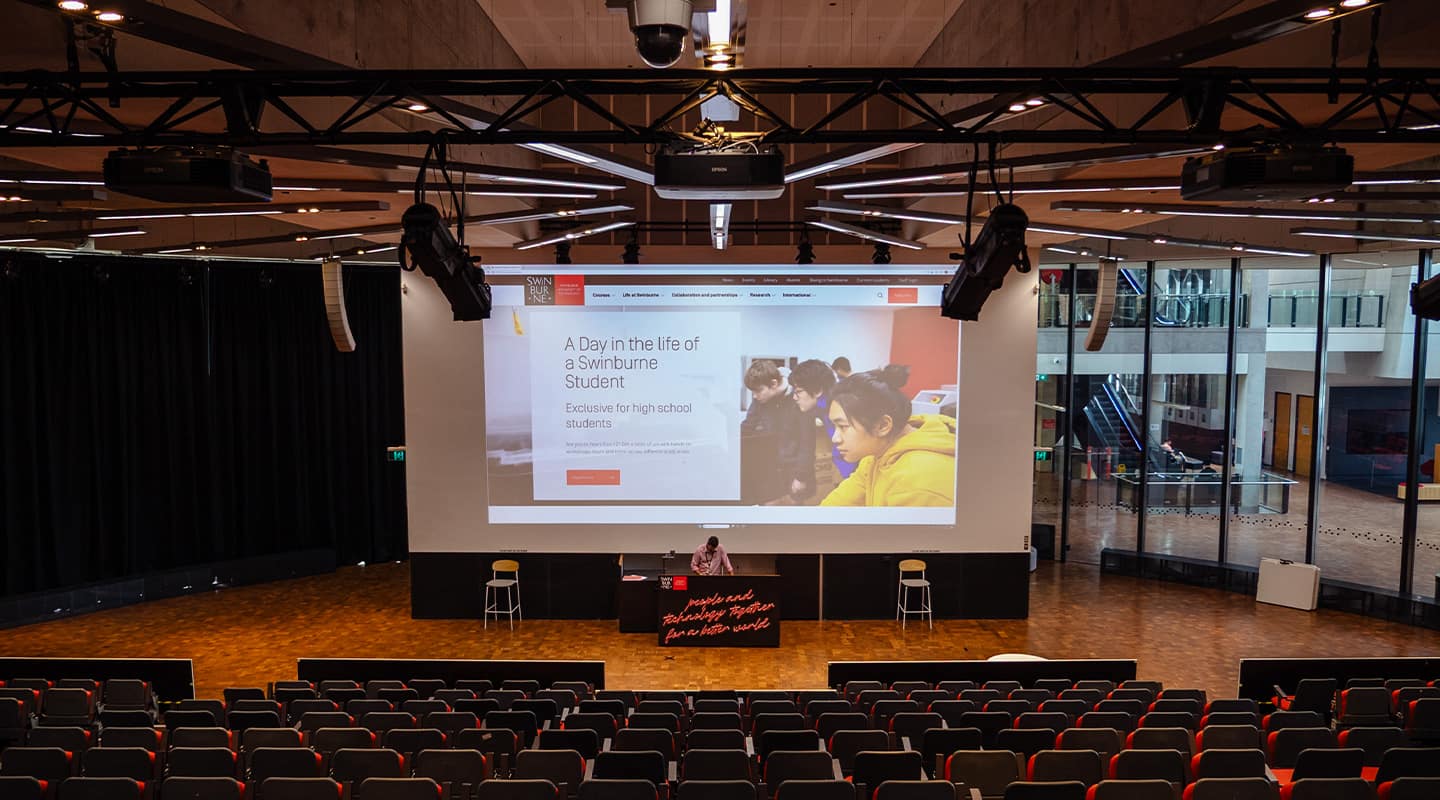
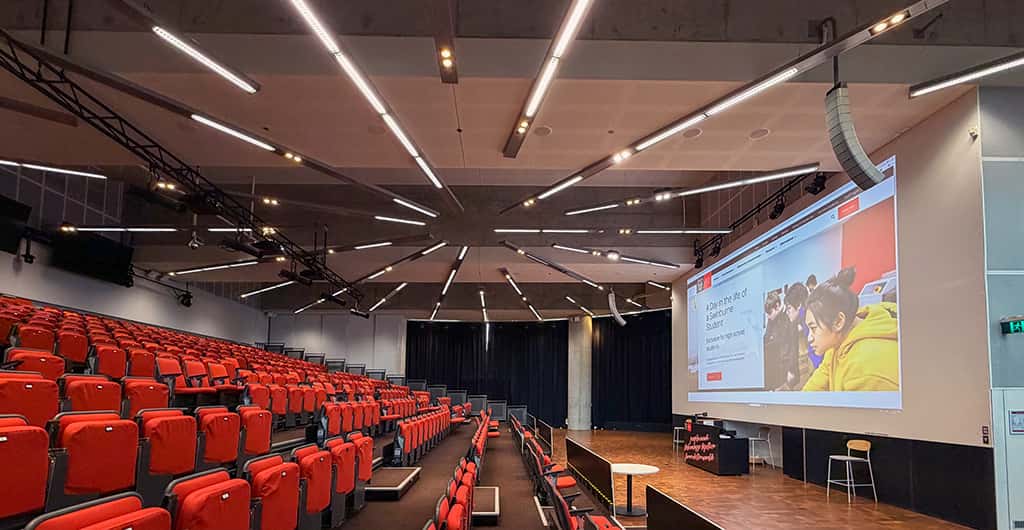
Recent work includes upgrading the central projector in the flagship lecture theatre to native 4K (20,000 ANSI lumen Epson). Not only does it significantly level-up the experience in the theatre it works hand in glove with the (recently unveiled) Virtual Universe visualisation lab. The new lab (which is situated just next door) is an immersive marvel but can only accommodate a limited number of people at a time. No problems, the lecture theatre, with the new Epson native 4K projector can be a 200-cap overflow or introductory space.
Projection, in Scott and Swinburne Uni’s experience, still delivers the best bang for buck when you need big, bright, reliable images across a diverse site. Oh, and, unlike a 100-ish inch LCD, a 110-inch projected image can still fit in the elevator.
SETTLING DOWN: STANDARDISATION
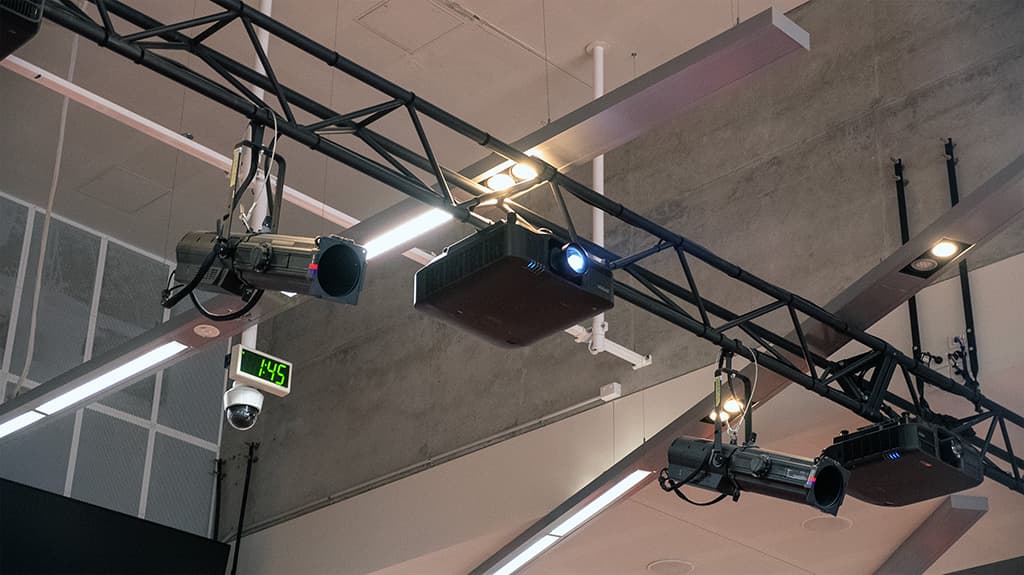
Scott Doyle is a vocal believer in standardisation. Control code stays consistent – “We haven’t really had to update any Epson control modules in the eight years I’ve been here.” Plug-and-play becomes reality. Hot spares can be rotated through projects so nothing sits on the shelf losing value. Staff build deep product expertise, and the manufacturer knows your setup inside out.
“You can train your staff to become very strong with that product set, and you end up with a much more stable fleet,” he explains. “It reduces downtime because if something does go down, you have the in-house expertise to get it going quickly – especially with how they’re configured, how they talk to Crestron’s XIO Cloud, and how they sit on the network.”
The tight relationship with manufacturers that comes with being a big customer delivers reliable information and the sort of bulk-buy opportunity that came along this time around. When the opportunity arose, Scott ran the numbers and seized it: “I realised we could get rid of every single lamp-based projector except for those special spaces.”
There is a trade-off, of course. Standardisation locks you into an ecosystem and you must be comfortable with the refresh costs and budget cycle. Scott acknowledges the criticism: “I hear a lot of people now saying it’s expensive and difficult to be locked into an ecosystem, and I completely understand those concerns. But at the same time, the other way means you lose all that in-house expertise.”
Scott used the Virtual Universe space by way of the exception that proves the rule (huge LED, different DSP etc), namely, if every room becomes its own ‘unicorn’ with different audio, control panels or software-defined systems, you suddenly need broader skill sets, more outsourcing and a shift to op-ex rather than cap-ex. “Both cost about the same amount of money – it’s really about what culture and direction your organisation wants.”
STABLE GENIUS
For Swinburne Uni – with roughly 700 learning spaces that include everything from streaming classrooms and high-flex rooms to basic lecture theatres, active-learning setups and specialist labs (plus those TAFE plumbing barns with dirt floors that still run the same sorta AV) – standardisation keeps a relatively lean team in control.
Scott is pragmatic: larger organisations might afford more agnostic approaches, but for Swinburne’s size and mix, the standardised path delivers stability, lower downtime and the ability to innovate in controlled ways — such as piloting Nureva microphone/speaker bars in streaming rooms after thorough proof-of-concept testing (they’ve now got 10 spaces using the Nureva HDL product).
The result is a fleet that runs reliably, a team that knows its gear inside-out, and an AV infrastructure that quietly supports the messy, real-world reality of today’s Australian higher education.







RESPONSES