

AV Case Study: Scitech Travelling Exhibitions
Perth’s Scitech science discovery centre has 10 of its interactive exhibitions wowing and educating kids around the word. Epson laser projection is a key part of the kit.

3 August 2026
Scitech’s travelling exhibitions have become a something of an unsung success story in the international science-centre world. From a Perth base, the not-for-profit organisation designs, builds and tours large interactive shows that fill 500 to 700sqm yet pack down into just two 40-foot sea containers. Ten of those exhibitions are currently on the road; some have been circulating for more than two decades. At the heart of their reliability sits a fleet of roughly 50 Epson projectors.
Jason Poletti, Program Manager for Travelling Exhibitions, has been at Scitech for 20-plus years. His background in electronic engineering and AV repair gives him a practical view of what survives the road.
“Scitech is a not-for-profit. We’re 48 percent funded by the WA state government and we have to raise the rest ourselves,” he explains. “The travelling exhibition model was the brainchild of Gary Foxton, one of the original account managers. The idea was simple: build an exhibition for Scitech, let it run here for a year, then send it out into the world. The hire fees come back and fund the next generation of exhibits for Perth.”
DESIGNED FOR THE ROAD
Every show is engineered around those two containers. That constraint keeps shipping costs manageable – especially when a single container to the United States can cost around US$15,000. Competitors often need four or even six containers for the same floor area, highlighting the Scitech team’s hard-won expertise in paring the tech and theming right down without impacting on the wow factor.
Once on the road, the exhibitions stay out for five to seven years before returning for a full refurbishment. “‘Top Secret’, a spy-themed exhibition we made in 2001, is still going strong after two refurbs,” Poletti says. “When it comes home, a whole new generation of kids experiences it as if it’s brand new.”
The same discipline applies to the technology. Short cable runs – usually under 10 metres – mean HDMI cable will generally cut it without extension. Content is driven by ASUS gaming PCs with dual graphics cards running Unreal Engine that deliver up to eight outputs from a single machine, always with a hot-swap backup ready. Touchscreens are mostly ELO units, chosen because replacements can be ordered on Amazon and arrive within hours in the United States.
LASER LIGHT THAT LASTS
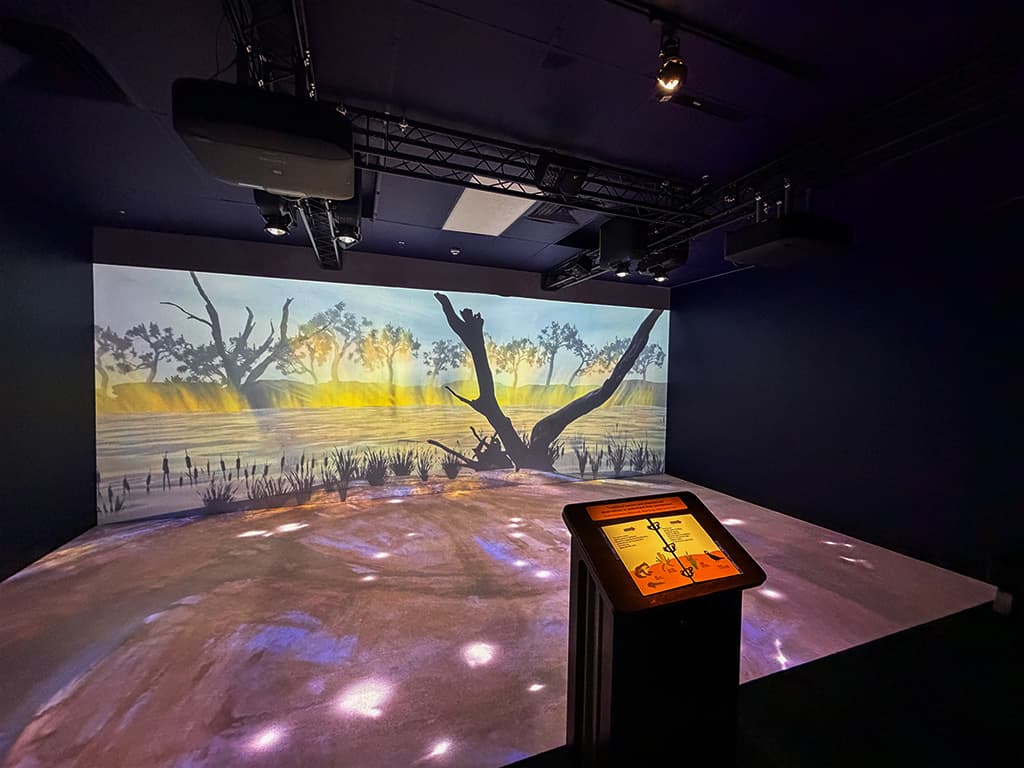
Projection, however, is where the real operational advantage appears. Scitech standardised on Epson laser projectors years ago and has stuck with the same model class and the same lenses ever since.
“The cost savings are huge,” Poletti notes. “When a projector reaches the end of its life we just buy another body. We don’t have to buy a new lens as well, which would add another 20 percent.”
Laser illumination has transformed reliability. “There are no more lamps. The picture is brighter and crisper, and we can get 20,000 hours with hardly any maintenance. Near 15 to 18,000 hours you start to notice a drop in brightness, but in a dark environment those projectors can still do another 10,000 hours if needed.”
Epson’s global support network matters just as much. “Everywhere Scitech has travelled we’ve had no problems getting brand-new Epsons within a few days,” he says. Projectors that leave Perth still have plenty of life left; many continue working in American science centres for another two or three years before being replaced locally.
FLEXIBLE BY DESIGN
Interactive projection exhibits – including interactive dancefloors, camera-driven experiences, immersive walls – are part of Scitech’s distinctive style. They demand more maintenance than a reliance on touchscreens, but kids everywhere prefer the hands-on approach.
Set up has been refined to a fine art. A multi-projector ‘Forest’ experience that once took two full days now goes up in about six hours. Mechanical trussing is handled by local crews; the final warping and blending is done remotely or on-site with MadMapper or Immersive View.
“”
Behind the touring success sits a complete in-house workshop: carpenters, metalworkers, electronics engineers, software developers, CNC and 3D specialists
“Immersive View is particularly handy,” Poletti explains. “You throw a big white silhouette on the wall, pull the corners in with a mouse, save it, and the next time you power up it’s perfect. I can remotely walk an Imagine Exhibitions technician through it in 20 minutes even if they’ve never used the software.”
That flexibility pays off when venues throw curveballs. On the ‘Destination Mars’ show, an 18-panel curved wall that needed three projectors in Perth had to shrink because of awkward columns in Detroit. Two panels were removed and the system dropped to two projectors, on the fly, without rewriting the entire show.
PARTNERS ON THE GROUND
In North America, Scitech works with Imagine Exhibitions. Scitech staff fly over for the first installation of a new show and hand over detailed manuals and videos. Thereafter Imagine’s crews handle most moves, with Scitech providing remote support for calibration. Once a year Poletti and a workshop colleague spend a month in The States checking laser hours, measuring light output and making sure every exhibition is running to Perth standards.
ENTIRELY BUILT IN-HOUSE
Behind the touring success sits a complete in-house workshop: carpenters, metalworkers, electronics engineers, software developers, CNC and 3D specialists. That vertical integration lets Scitech keep control of both the creative vision and the practical realities of life on the road.
The result is a rare combination: exhibitions that still feel hands-on and exciting after years of constant packing and unpacking, and a projection platform that simply works – bright, consistent, and supported wherever the containers land.
As Poletti puts it, the Epson fleet is not just another piece of kit, it is one of the understated reasons a mid-sized science centre in the world’s most isolated city can keep 10 large exhibitions circulating the globe, year after year, and still bring the money home to invent the next one.
Scitech: scitech.org.au
Epson: epson.com.au








RESPONSES