

Review: Episode Business Music System
A straightforward, integrated music system for businesses wanting a legit commercial audio solution without the bespoke pricing.

28 August 2026
Commercial audio has always had a slightly awkward middle ground. At one end of the market you’ve got genuinely high-end installed audio systems with dedicated DSP platforms, enterprise control, commissioning software and enough processing horsepower to launch a small satellite. At the other end of the spectrum? You might have a Bluetooth receiver zip-tied above a ceiling tile feeding some kinda 100-Volt amp or, a mini UE Boom-style pumpkin sitting on a shelf somewhere.
Increasingly, venues not in the top tier are seeing good commercial reasons for occupying a middle ground: a proper, professional audio solution that covers the whole venue, sounds great and is easy to control without the bespoke pricing.
THE MIDDLE GROUND
This is the gap the Episode Business Music Solution – or EBMS – seeks to occupy.
And it’s an interesting proposition because it’s less about inventing anything new, and more about simplifying commercial audio deployment for integrators who don’t necessarily want every café, gym, salon or shop to become a labour-intensive, roll-your-own engineering exercise.
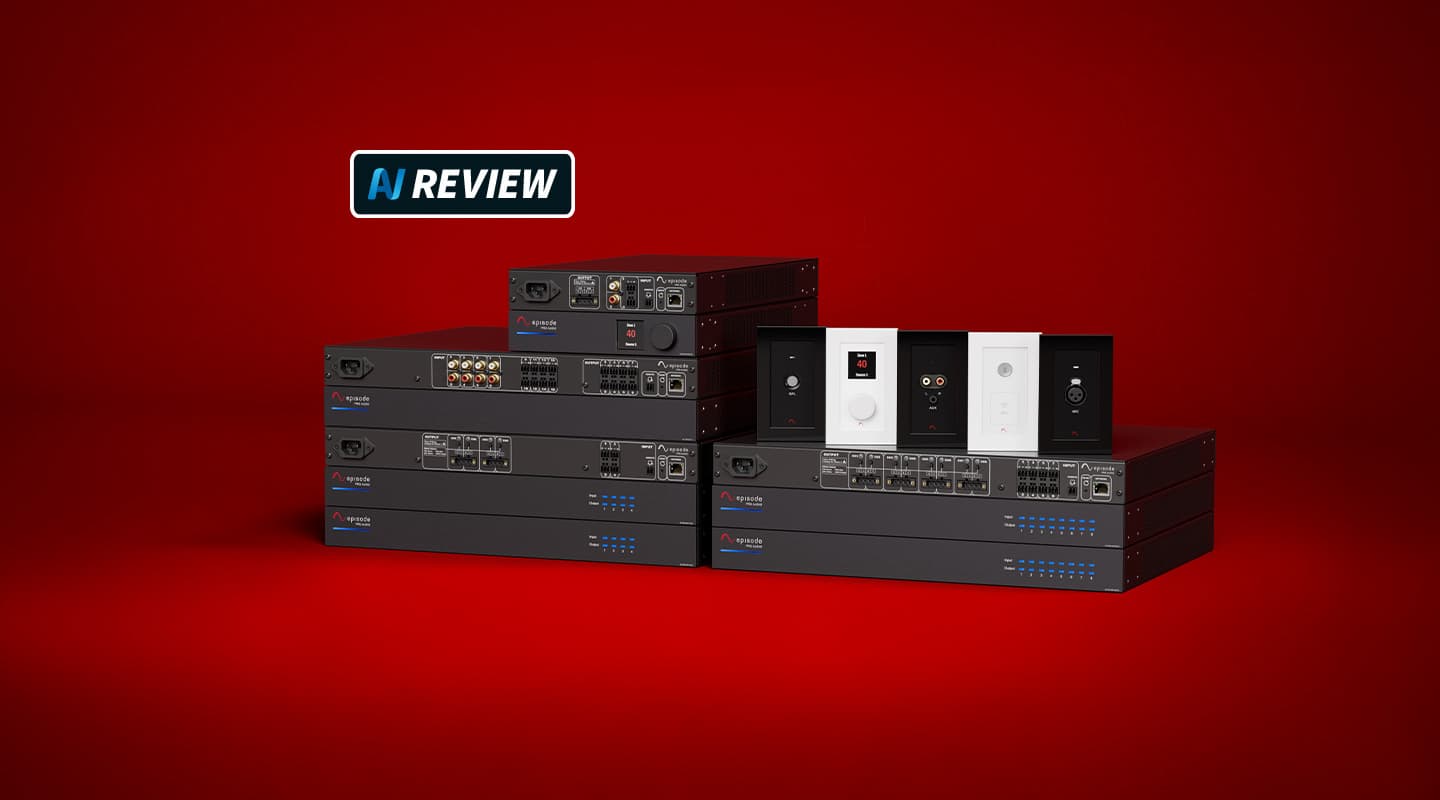
Instead, Episode has assembled an ecosystem of DSPs, amplifiers, mixers and wallplates that are purposefully designed to behave as a single platform.
What’s striking about EBMS is that it feels less like traditional pro audio and more like commercial infrastructure. And I mean that as a compliment.
FAST DEPLOYMENT
EBMS is designed for fast deployment, predictable behaviour and remote visibility. Systems that can be rolled out across multiple sites without every install becoming its own science project, particularly once you bring OvrC remote monitoring into the equation.
The OvrC integration is, quietly, one of the more important parts of the EBMS story because it shifts these systems from being purely one-off installation products to service-managed systems. Integrators can remotely monitor zones, adjust levels, tweak EQ, switch sources and troubleshoot problems without sending a van.
THE SYSTEM
Beyond OvrC, the platform itself is fairly comprehensive. There are DSPs capable of handling up to 16 sources across eight zones, amplifier options with selectable 100V, 4-ohm and 8-ohm operation, wallplates for source input and zone control, plus paging and microphone integration.
There’s also some surprisingly thoughtful functionality built in. SPL wall sensors, for example, allow the system to automatically compensate for ambient noise levels.
There’s also a strong emphasis on presets and operational simplicity, which is great for non-technical hospo staff or retail sales assistants.
IT’S A SNAP
Episode is a Snap One and ADI brand, which means EBMS can plug into a more sophisticated system that relies on Control4 and its MoIP AV-over-IP infrastructure.
This might prove important to Snap ADI-centric integrators – potentially residential-focussed SIs getting more into commercial. If a client is on a growth path, then there are familiar systems that can help to easily scale.
To sum up: there are certainly more powerful DSP platforms available. More sophisticated control ecosystems. More complex networked audio environments. But that’s not really the point here.
EBMS is aimed squarely at the middle ground of the commercial market that simply wants high-quality distributed audio without the integration overhead traditionally attached to it.
ADI: (03) 8795 1725 or adiglobal.com





RESPONSES