
AV Case Study: Crown Perth
Crown Perth AV department does things its own way, squeezing more out of Q-SYS than most.

24 August 2026
Interview:/ Christopher Holder
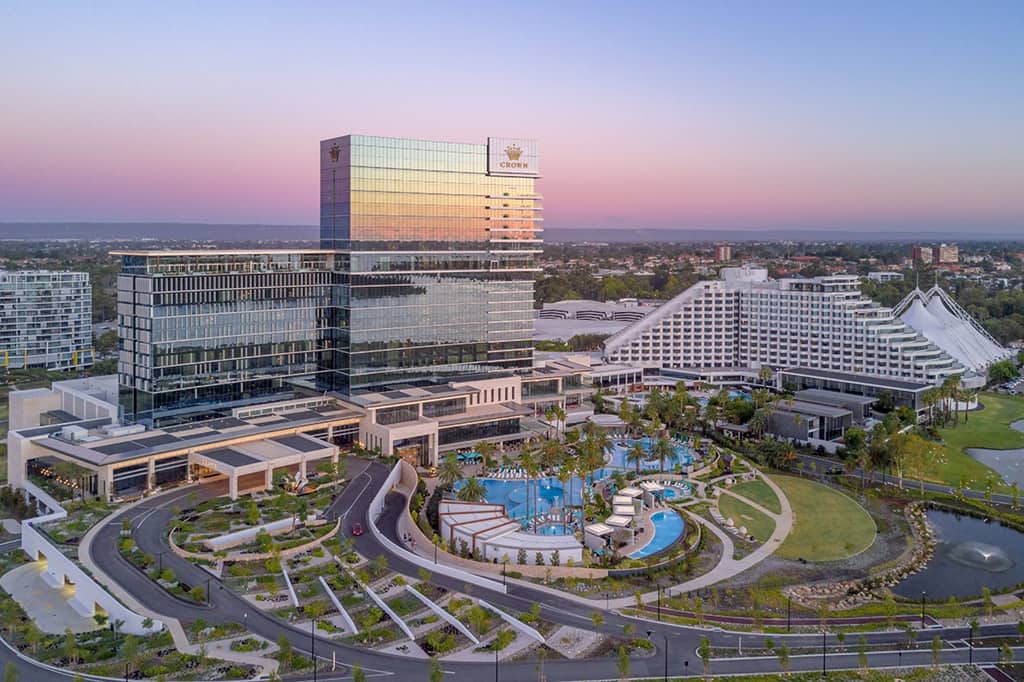
Crown Perth is not a typical AV environment. It is a 40-year-old, 24/7 entertainment complex that never really sleeps. Gaming floors, hotels, restaurants, lounges, a theatre and live performance spaces all demand reliable audio and control, yet the venue has very few genuine shutdown windows. Upgrades happen in the small hours or on the handful of public holidays when the doors briefly close.
At the centre of this operation sits an unusual in-house team. Jeremy Prestwood, Audiovisual Development Analyst, has been at Crown for 34 years. He started as a casual lighting technician in the old Burswood Theatre days and has remained inside the Entertainment department ever since.
“We’re not part of facilities and we’re not part of IT,” he explains. “We’re still part of the entertainment department. The same crew that looks after DJs, bands and live venues also does the installs and the systems work. I think that’s a fairly different approach to most AV roles.”
That live-events background shapes everything. Audio ducking that recovers smoothly after a fade, karaoke processing that gives clients controlled options without handing them every parameter, and paging systems that actually feel natural to use are all informed by years of standing at the desk rather than simply programming boxes.
BRINGING IT IN-HOUSE
Over the past five or six years Jeremy has steadily pulled design, programming and much of the implementation in-house. Larger physical installs still use contractors, but the intellectual property and the day-to-day responsiveness now sit inside the building.
“We’ve been burnt in the past,” he says. “You have Company A do a small install, two years later you need a change and Company A no longer exists, or the person who wrote the code has moved on.”
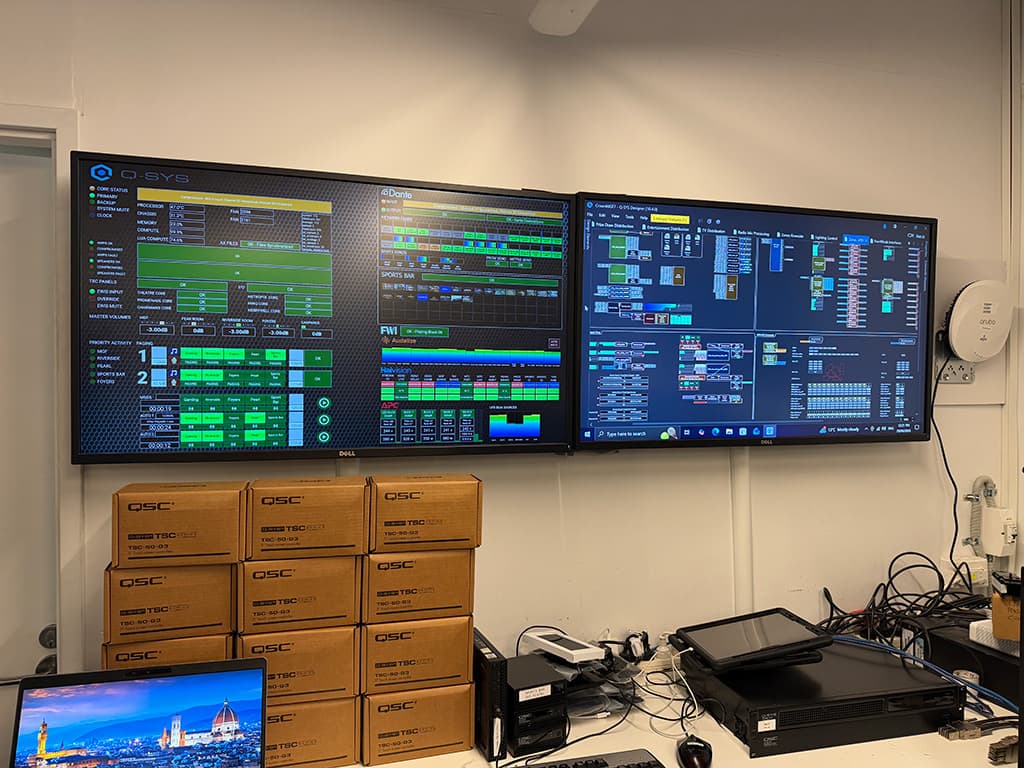
Q-SYS has been central to that shift. The design files live on the cores. With the correct passwords the team can pull the current system, make changes and push them back. Documentation, code and operational reality stay together.
HOW THE WEST WAS WON… BY Q-SYS
Before the current platform, Crown had a patchwork of systems accumulated over decades. The gaming-floor audio had progressed from early MediaMatrix into nWare, but the business kept asking for more: automated messaging, scheduling, tighter integration and better diagnostics.
“I basically built a new system virtually on a couple of different platforms,” Jeremy recalls. “With a lot of the other audio systems it was ‘that’s great, but I still need a control system, I still need a scheduling system, I still need message playback’. With Q-SYS I could achieve most of it out of the box.”
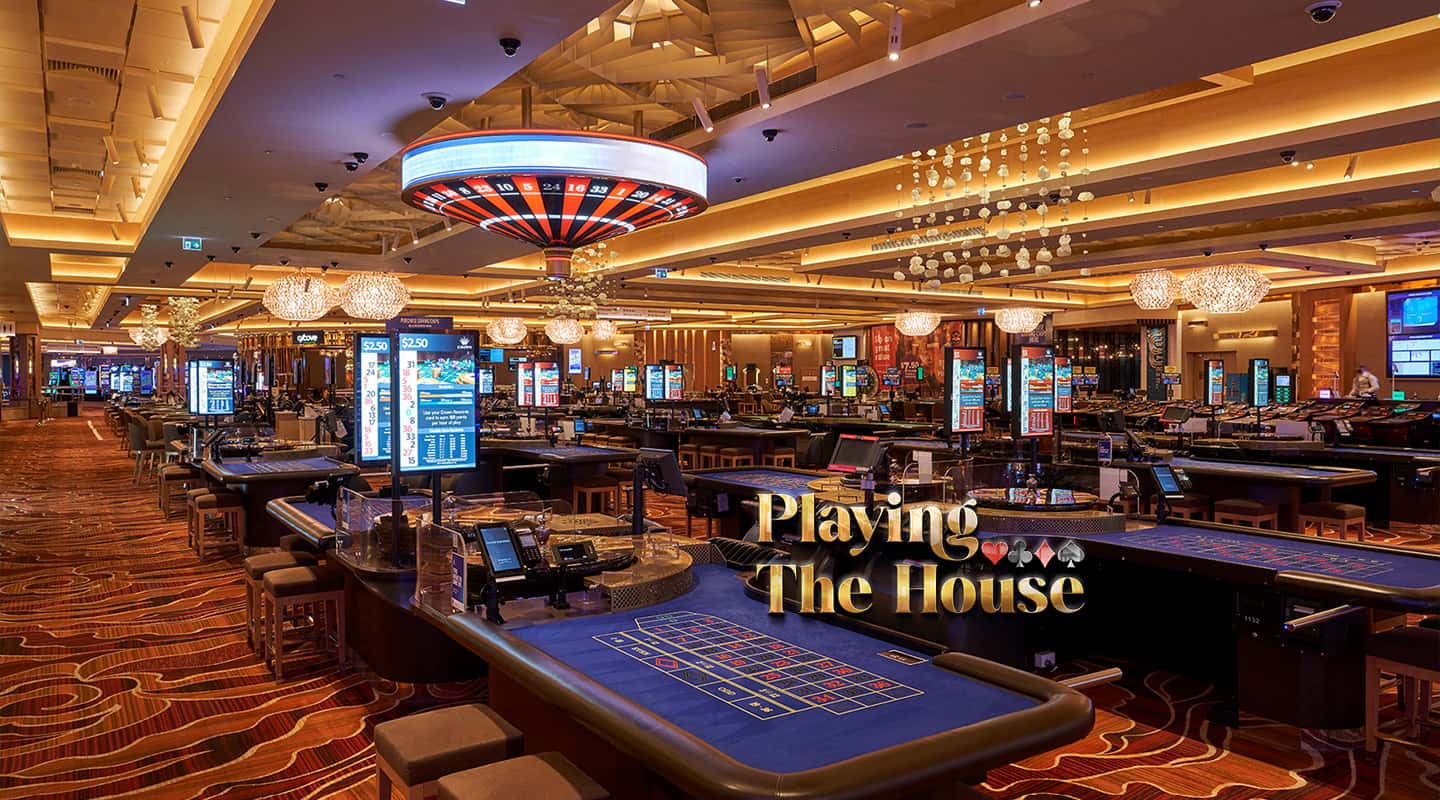
Compliance-critical automated announcements on the gaming floor were a particular driver. Everything had to be logged and reliable. Once the main gaming-floor system was running on Q-SYS, the same approach began migrating outwards as older systems aged out or failed.
CORES, MUSIC & REDUNDANCY
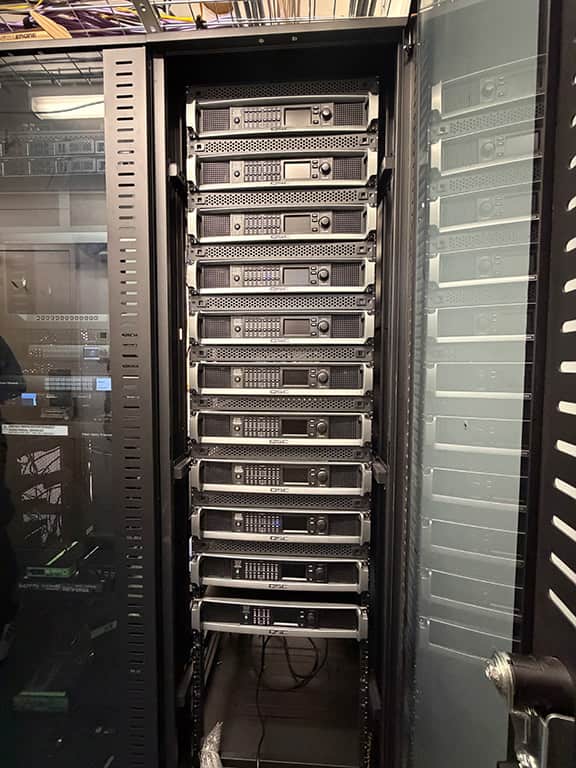
The architecture is deliberately hybrid. The gaming floor runs on larger Core 510is. Each hotel has its own core (or set of cores) with redundancy. The Crown Towers hotel, for example, now runs three sets of cores to provide headroom for future restaurants.
Background music is handled by a pair of enterprise-grade Audalize music servers feeding roughly 30 zones across Dante. Dual servers mean a failure on one side is invisible to the floor. Jeremy notes the primary server has delivered more than two and a half years of continuous 24/7 uptime so far.
“We try to make everything as backed-up as we can in a 24/7 venue,” he says. Cores talk to each other for status, remote access is available from the office, and signal flow remains highly visible.
THE INCREMENTAL ADVANTAGE
Because the venue is 40 years old and always trading, wholesale rip-and-replace projects are rare. Q-SYS has enabled a steady, venue-by-venue migration.
“Once you get those central core modules in, you can roll venues over one by one,” Jeremy explains. “If a restaurant is closed Monday and Tuesday, you come in early, swap the amplifiers, swap the control, retune and you’re done. A lot of the programming is already prepped in the core.”
New venues such as the Urban Food District and Gladstones wine bar opened with little more than a network amplifier and a touchscreen. The backbone was already waiting. When an older system fails, the team can often simply migrate that space onto Q-SYS rather than nursing legacy hardware back to life.
“”
We quite often deploy the UCIs and basic display first, then add the code later while the system is running

CODE THAT STAYS ALIVE
Jeremy Prestwood’s programming background stretches back to Commodore BASIC, Assembler, C and C#. He finds Lua a good fit for Q-SYS: lightweight and precise.
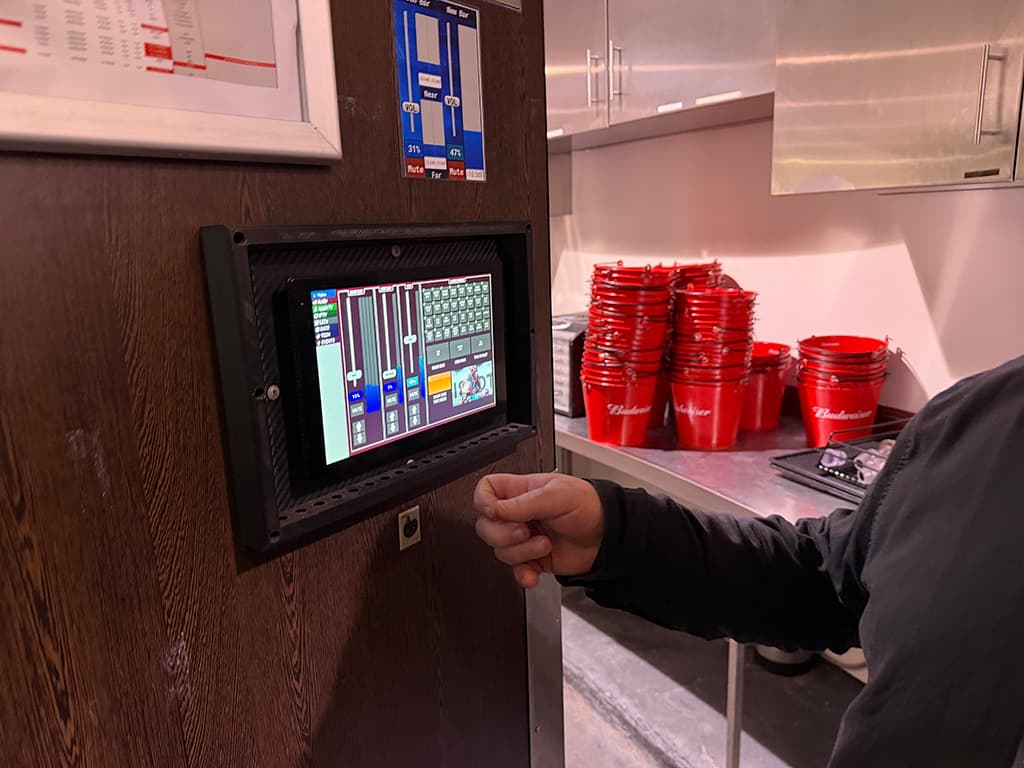
“I tend to do a lot of my Q-SYS work very heavily code-based,” he says. “The fact that you can make changes to the script on a live system without having to redeploy is actually very useful. We quite often deploy the UCIs and basic display first, then add the code later while the system is running.”
That ability has practical value in a live venue. For example, when a new entertainer in the Urban Food District left longer gaps between songs and the ducking recovered too early, Jeremy adjusted the timing remotely from home without taking anything offline.
BEYOND BACKGROUND MUSIC
The same platform now handles theatre dressing-room paging with individual Axon C1 controllers and volume settings, house lighting via streaming ACN (with cleaners’ modes and show overrides), karaoke microphone processing with selectable effects, and integrations to Tripleplay IPTV, Helvar lighting, signage systems and streaming appliances.
“It’s the clarity of what’s going on inside it,” Jeremy notes. “When something strange is happening you can look and see where the signals are going. There are meters. You can listen to a point in the chain. It’s almost old-school analogue in that respect – not just a black box.”
A LONG GAME
The public areas that fall under Jeremy’s main remit are now largely complete after six or seven years of steady work. The ballrooms remain a different use-case and will likely be addressed later. Hotel room upgrades continue. The cycle never really ends.
“I have a feeling that by the time we’ve done all this we’ll be back to changing out the Core 510s!” he laughs. The difference is that the change will be hardware only. The program, the logic and the operational knowledge stay in place.
In a complex, always-on entertainment venue that cannot afford long outages or orphaned systems, that continuity has become the real value of the platform. Q-SYS is no longer just the sound system, it is the house system.
TAG (Q-SYS): tag.com.au


RESPONSES