

AV Case Study: Monash Uni Audio DSP Upgrade
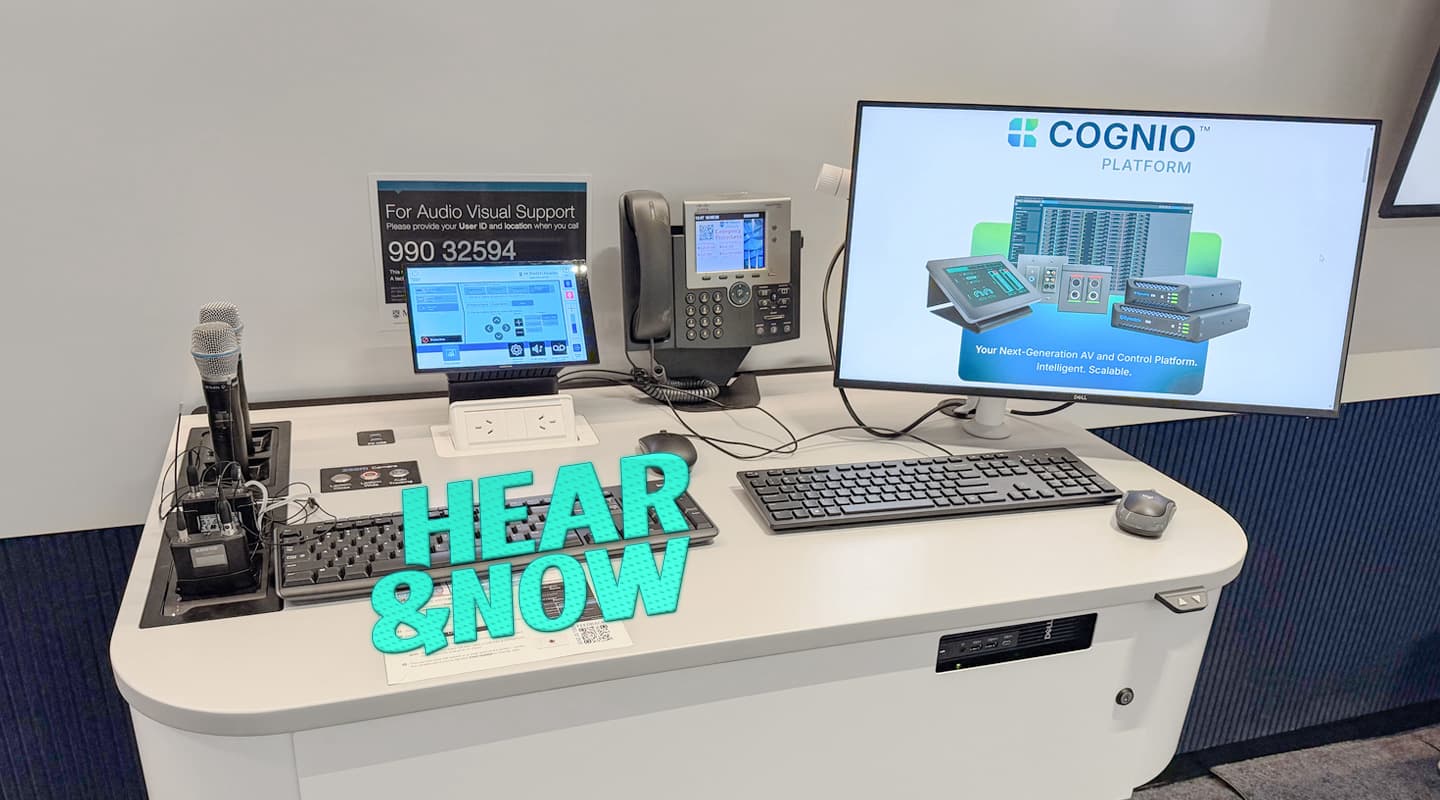
When Monash Uni went to upgrade its outdated audio DSP it took the bold step of going all-in on a new platform – Symetrix Cognio.

17 June 2026
Monash University has become an early adopter of Symetrix’s new Cognio DSP platform, deploying it at the heart of its collaborative learning environments. For Peter MacLean, Monash’s Lead Audiovisual Architect, the decision wasn’t about chasing the latest AV trend. It was about protecting one thing above all else: learning outcomes.
For a university that has spent the last decade reshaping the classroom experience around collaboration, intelligibility and student engagement, Cognio couldn’t have arrived at a better time.
AUDIO: CENTRAL TO LEARNING
Peter MacLean has spent more than 20 years around Symetrix products, first encountering the brand through studio-style voice processing equipment before later specifying its DSPs in commercial AV projects.
“What drew me to Cognio originally was the audio quality,” explains Peter. “A lot of commercial DSPs available at the time had, in my opinion, fairly average – and sometimes quite poor – audio quality. They would do the job, and the focus was always on high channel counts, flexible configuration and clever features, but very few people talked about actual sound quality.”
For Peter, that omission misses the entire point of AV in education.
“The whole reason we install audio systems is so that people can hear each other clearly, whether that’s a student hearing an academic, an academic hearing students, or students hearing one another, whether they’re in the room or joining remotely via Zoom.
“All that interaction needs to be clear to facilitate learning. The better the communication, the better the learning becomes.”
That philosophy underpins Monash University’s broader approach to teaching spaces. Rather than treating AV as supporting infrastructure, the university sees audio intelligibility as a direct contributor to student comprehension, concentration and engagement.
“People’s brains only have a finite capacity,” says Peter. “They’re already absorbing new concepts, trying to place them in the context of what they’ve learned previously – pre-reading, videos, last week’s class, last year’s classes, and their whole life experience.
“If the audio is poor, their brains are working overtime just to decipher the words, leaving less capacity for understanding context and meaning.”
BELL RINGS ON CHALK ’N’ TALK
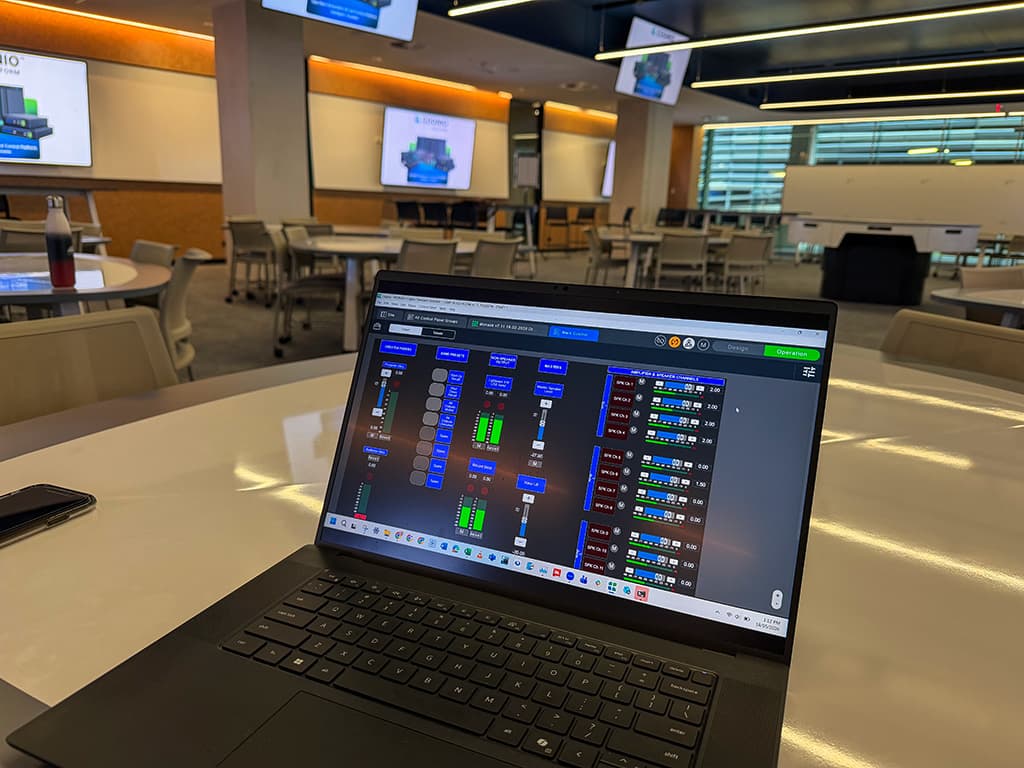
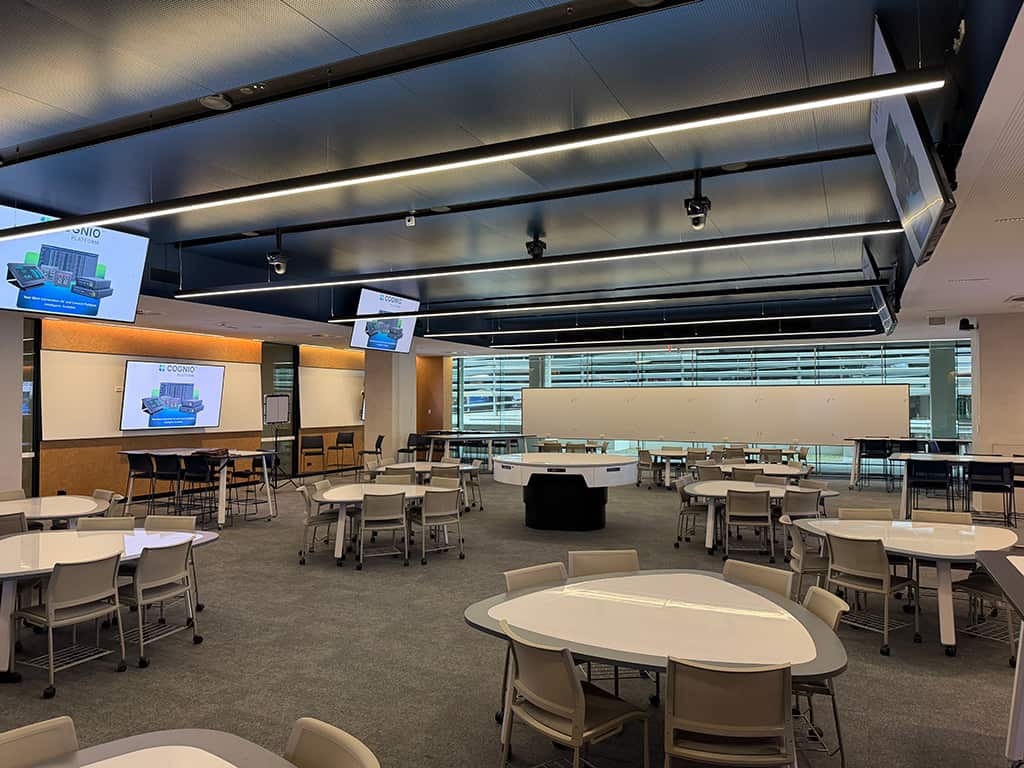
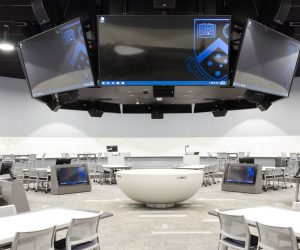
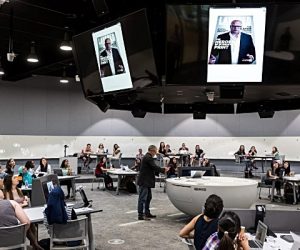
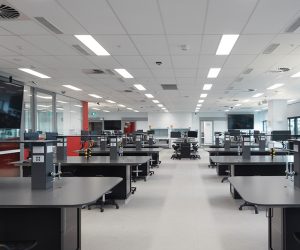
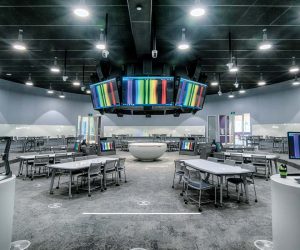
Monash has been at the forefront of moving away from traditional didactic teaching models towards collaborative learning environments. Entire buildings are designed around that pedagogy:
“Students now absorb the foundational information at home through videos and readings, then come into class for active discussion and application. The academic becomes a facilitator, drawing understanding out of the students rather than simply delivering information.”
The change fundamentally alters the demands placed on AV systems.
“In these rooms, students sit around tables – typically six per table – discussing and working together. In a large 150-student space, that creates a significant amount of conversation. Good acoustics are essential so they can hear one another clearly without it becoming a cacophony of noise.”
Monash supports those environments with headset microphones for academics, handheld microphones for contributing students and guest speakers, and wireless gooseneck microphones at every table to capture group discussion for the livestream.
“It’s not just Q&A, it’s genuine discussion and facilitation,” says Peter.
Hybrid learning only increases the challenge: “We also have remote students who need to hear the in-room conversation clearly, and the in-room students need to be heard by those remote participants. That’s where high speech intelligibility becomes critical.”
INTELLIGIBILITY WITHOUT FATIGUE
MacLean argues that many systems pursue intelligibility at the expense of listener comfort.
“Some systems achieve intelligibility by stripping out too much, making dialogue sound thin and fatiguing,” he says. “We want it to feel like the person is simply standing there talking to you.”
That becomes even more important in a university environment with a high quota of international students, who invariably will have a diverse range of accents and varying levels of English proficiency.
“We have students and academics from a whole range of different cultural backgrounds. That adds complexity, so we need high-fidelity audio with excellent speech intelligibility that still sounds natural, rich and warm. If the system stays out of the way and supports learning without drawing attention to itself, people stay engaged longer and learn better.”
For Monash, engagement is directly tied to student success: “Our bottom line is learning outcomes,” says Peter.
“”
We evaluated the marketplace, spoke to other users, and looked at their experiences. Cognio arrived at exactly the right moment, giving us a perfect transition to a more modern system
BETTING THE HOUSE ON COGNIO
Monash’s deployment is significant because Cognio is a brand new platform. Peter MacLean openly acknowledges the university effectively became an early beta site.
“We’ve jumped in early as beta testers,” he says. “But we have a long relationship with Symetrix and great confidence in the management team. They’ve worked closely with us on site and remotely to resolve issues quickly.
At every step of the way, Symetrix’s Australian distributor, PAVT, has also partnered with Monash Uni. PAVT’s Technical Support Manager, Ben Clarke, has been on the Cognio journey with Peter and the team, investing in the kind of value-add support that you hope for from an AV distributor: “I’ve known the PAVT team for decades and I can’t fault their commitment throughout this extended journey. Between PAVT and Symetrix, the support has been exceptional.”
Monash Uni might be early to the Cognio party but the timing was impossible to ignore.
“The product we were previously using reached end of life,” says MacLean. “We had to decide whether to move to that manufacturer’s new hardware and software or look at the wider market. We did the latter.
“We evaluated the marketplace, spoke to other users, and looked at their experiences. Cognio arrived at exactly the right moment, giving us a perfect transition to a more modern system.”
AUDIO QUALITY MATTERS MORE THAN EVER
Peter MacLean rejects the idea that modern DSP platforms all sound essentially the same.
“There’s actually plenty of variation,” he says. “There are good products out there, but we chose Symetrix because our focus is making sure people can hear and communicate better. When that’s your priority, you select the best audio quality you can, and one that is still at a very competitive price point.”
Monash conducted direct A-B comparisons during its pilot deployment.
“We did an A-B test during our initial pilot last year, swapping between our old DSP and Symetrix,” says MacLean. “Everyone on the team could instantly hear the improvement.”
He points not only to microphone preamps and signal paths, but also to how the DSP handles dynamics processing and EQ.
“Many systems add harshness when you apply EQ or compression. With Symetrix, you can compress and EQ without the processing becoming obvious. It sounds like a good studio compressor – it just does the job and stays out of the way.”
AVoIP WITHOUT THE COMPLEXITY
Beyond audio quality, Cognio also aligned with Monash’s broader, Dante-led, AV-over-IP strategy. And Cognio’s management capabilities were compelling for a university operating at enterprise scale.
“As a large university with a sophisticated enterprise network, we have strict security and multicast restrictions,” says Peter. “We use dedicated Netgear AV switches for our Dante and Crestron NVX traffic, which keeps everything isolated.
“Symetrix Cognio gives us full remote management of Dante routing and DSP configuration from anywhere on campus, or between campuses, without relying on external tools. That’s a huge advantage.”
The workflow improvements have also changed how Monash approaches DSP deployment and support.
“The open architecture in Cognio is much cleaner,” says MacLean. “Modules link together with minimal wiring, and every connection has metering so you can see signal flow, levels and overloads in real time.”
Unlike many traditional DSP platforms, Cognio also removes the lengthy compile-and-upload process.
“You make a change, hit resync, and it’s live in less than a second,” says MacLean. “Other rooms on the same hardware remain completely unaffected. That’s been transformative for us.”
“”
we chose Symetrix because our focus is making sure people can hear and communicate better. When that’s your priority, you select the best audio quality you can
SCALING ACROSS CAMPUS
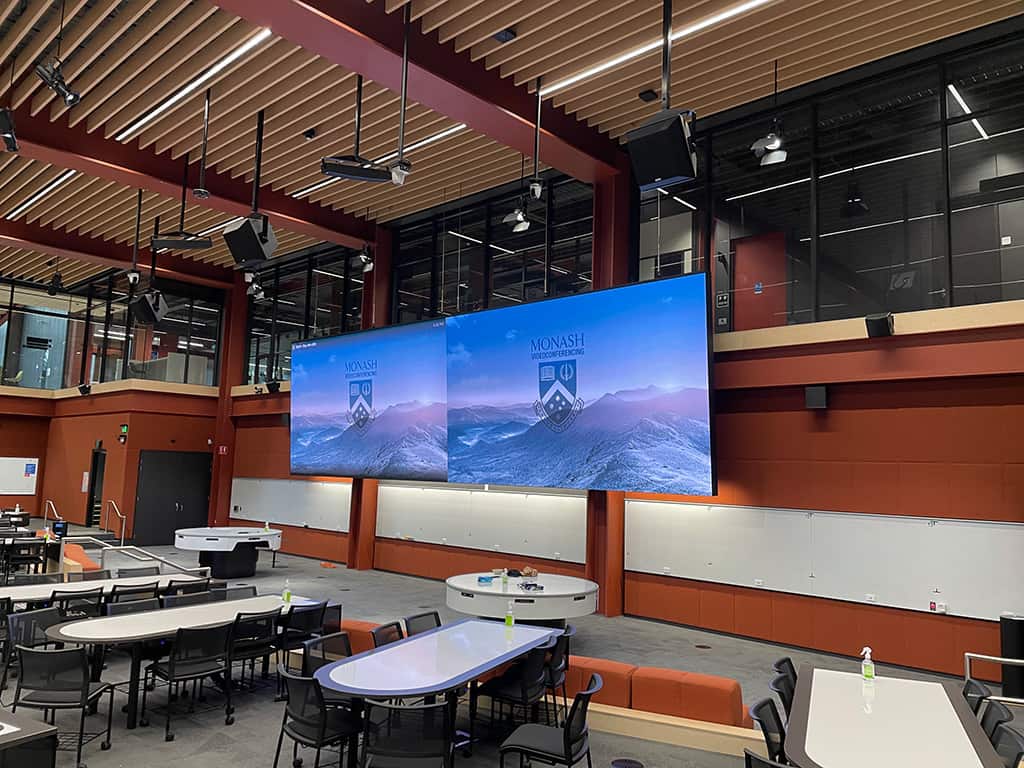
One of Monash’s major concerns was scalability. MacLean had seen competing DSP platforms perform well in isolated deployments before failing under enterprise-scale rollouts.
“I’ve seen other universities pilot a DSP system successfully in a single space, only to run into major problems when scaling to 20, 30 or 100 rooms using centralised processing,” he says.
“They couldn’t add a new room without taking everything else offline, meaning all work had to be done after hours. Cognio’s flexible approach solves that problem completely.”
That scalability now makes Cognio Monash’s standard DSP platform moving forward.
“As we roll out new DSPs, Cognio will be the unit we install,” says MacLean. “As the smaller Cognio C10 and new modules are released over the coming months, we’ll start deploying them across other rooms, not just our collaborative learning spaces, but also smaller rooms and seminar spaces.”
The rollout will also extend into Monash’s microStudios (single button academic recording studios), where lecturers produce short-form teaching content for students to consume before class.
“These rooms will be among the next to receive Cognio DSPs because it will significantly improve the audio quality of those recordings,” says Peter.
STANDARDISING THE STUDENT EXPERIENCE
Consistency across campus has become another major advantage: “In the past, different integrators would deliver slightly different results,” says Peter MacLean. “Now we have standards, templates and processes that deliver the same high-quality experience every time.”
Monash has even developed its own simplified web front-end to accelerate deployment: “It uses pre-configured profiles so integrators can set up a room quickly and consistently without needing deep DSP expertise,” explains MacLean. “Our goal is for integrators to achieve pristine results in 10 to 15 minutes.”
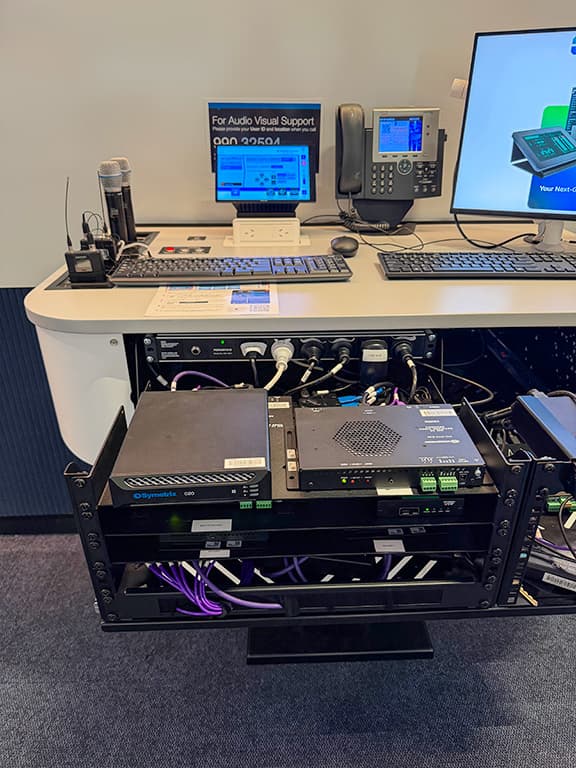
The efficiencies are significant. According to MacLean, the new Cognio C20 units can replace up to 17 rack units of legacy DSP hardware in less than half a rack unit while supporting up to 62 microphones.
“That’s a massive saving in space, power and cooling,” he says.
LISTEN & LEARN
Monash University is a large institution, with some 90,000 students on the books and more than 200,000 IT endpoints across various campuses. So for any purchasing decision, the stakes are high. Which makes this story more than a tale of a DSP platform refresh. Cognio’s approach is consistent with Peter MacLean’s AV philosophy and his laser-like focus on great sound.
“When that’s your priority,” he says, “you select the best audio quality you can.”




RESPONSES